








Steel grade is one of the most important factors to consider when purchasing scaffolding materials. It affects the mechanical properties, fabrication performance, durability, and suitability of scaffold components for different construction environments. Whether contractors are purchasing scaffolding tubes, ringlock systems, cuplock scaffolding, steel planks, or scaffold frames, selecting the appropriate steel grade helps balance structural performance, product quality, and overall project cost.
However, choosing the right steel grade is not simply a matter of selecting the strongest material. You must also consider applicable standards, component dimensions, loading requirements, manufacturing processes, corrosion protection, and the intended service environment. This guide explains the key factors to consider when selecting steel grades for scaffolding materials.
1. Understand the Mechanical Properties of Steel
Before choosing a steel grade, it is important to understand the mechanical properties that influence scaffolding performance.
Yield strength refers to the stress at which steel begins to deform permanently. It is an important consideration when evaluating materials for structural scaffold components.
Tensile strength describes the maximum tensile stress a material can withstand before failure during a tensile test.
Ductility indicates the ability of steel to deform before fracturing. Appropriate ductility can be important when components experience unexpected stresses or undergo fabrication.
Toughness describes a material's ability to absorb energy before fracturing, particularly under impact conditions.
These properties should be evaluated together. A higher yield strength does not automatically mean that a scaffolding component is safer or more suitable. Structural design, dimensions, connection details, manufacturing quality, and applicable product standards also determine overall performance.
2. Identify Common Steel Grades Used in Scaffolding
Different steel grades are used in scaffolding manufacturing, depending on the product specification and target market.
For example, Q235 steel is commonly used in Chinese steel products and is found in various scaffolding components. It is generally associated with good formability and weldability when the material and fabrication process are appropriate.
Q355 is another Chinese steel grade with a higher specified minimum yield strength than Q235 under relevant product specifications. However, whether it is suitable for a particular scaffold component depends on the applicable standard, design requirements, and manufacturing process.
In European markets, S235 and S355 grades may be specified for certain structural steel applications. These grades should not be assumed to be directly interchangeable with Q235 or Q355 without checking the relevant standards and material requirements.
For scaffolding tubes, standards such as EN 39 and BS 1139 may be relevant, depending on the product and market. You should confirm the exact specification rather than selecting materials based on a grade name alone.
3. Match Steel Grade to the Scaffolding Component
Not every scaffolding component has the same material requirements. The appropriate steel grade depends on its intended function and design.
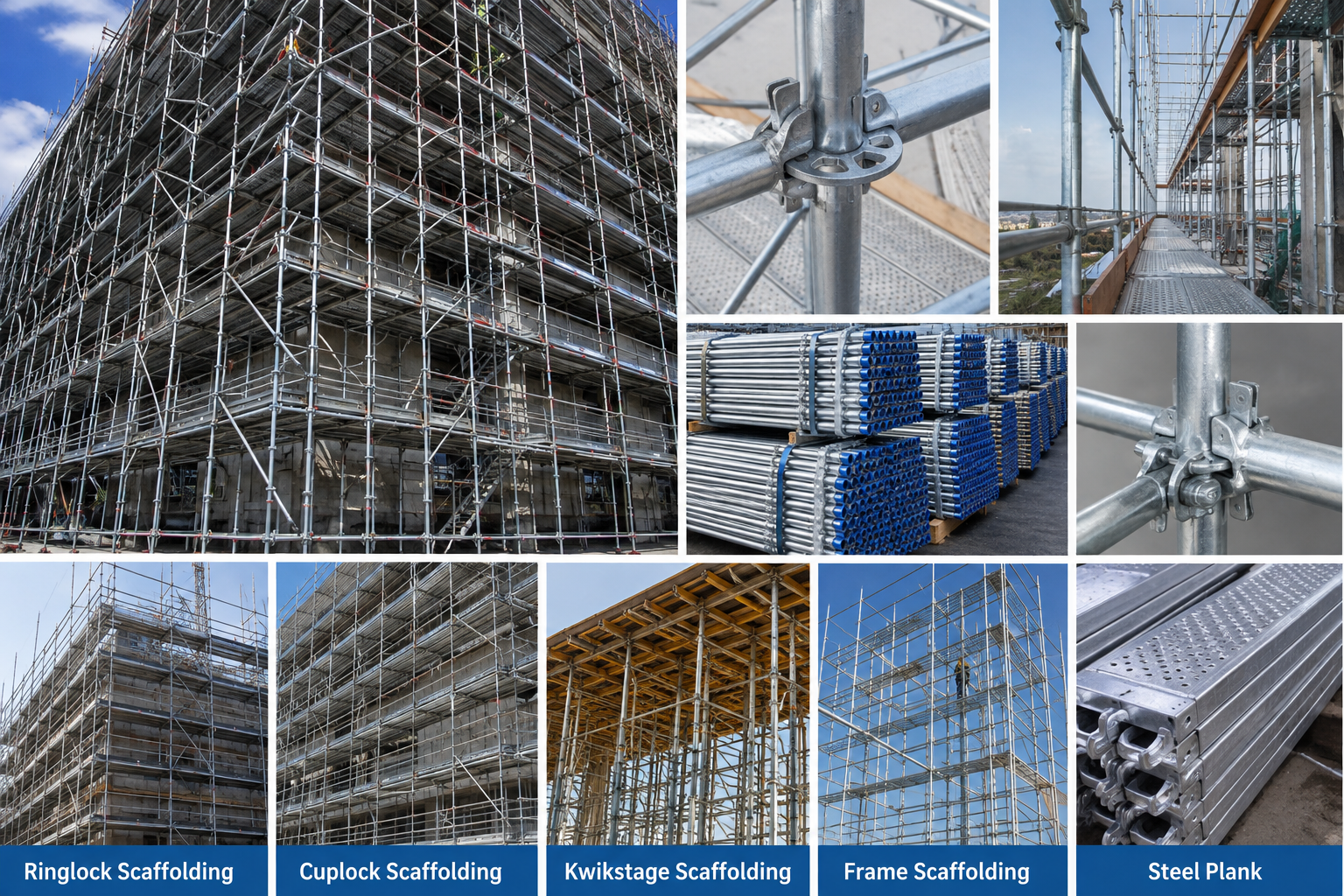
Scaffolding tubes: Tubes used as standards, ledgers, and braces require appropriate strength, dimensional consistency, and fabrication quality. Tube diameter, wall thickness, unsupported length, and connection conditions all influence performance.
Ringlock and cuplock scaffolding: Modular systems contain standards, ledgers, braces, and connection components. Material selection must account for both the individual components and the complete system's structural design.
Steel scaffolding planks: Planks need appropriate strength, stiffness, surface characteristics, and resistance to deformation under the intended working loads. Their design and testing requirements are as important as the steel grade.
Scaffold frames and ladder beams: These components may use welded steel sections or tubes. Steel properties, joint design, welding quality, and dimensional tolerances must be considered together.
Selecting one steel grade for every product without considering its function may result in unnecessary cost or unsuitable performance.
4. Consider the Load Requirements and Structural Design
The required steel grade should be determined in conjunction with the intended scaffold configuration and design loads.
Factors to consider include the number of working platforms, workers and materials carried, scaffold height, bay dimensions, bracing arrangements, support conditions, and environmental loads such as wind.
Higher-strength steel may be appropriate for certain engineered applications, but it does not automatically increase the safe working load of an entire scaffold. Connections, buckling resistance, component geometry, and overall stability can govern structural performance.
Contractors should follow the applicable design standard and obtain the necessary technical documentation. They should not estimate scaffold load capacity from steel grade alone or exceed the manufacturer's stated limits.
5. Evaluate Weldability and Manufacturing Quality
Scaffolding products frequently require cutting, forming, punching, and welding. The steel grade must be compatible with these processes.
Steel with suitable chemical composition and weldability can help manufacturers produce consistent joints and finished components. Welding procedures should be appropriate for the material, thickness, and component design.
You should also consider the manufacturer's control of raw materials, forming tolerances, welding operations, and finished-product inspection.
Even steel with excellent mechanical properties may produce an unreliable component if it is poorly fabricated. Material certificates, dimensional inspection records, and relevant product test reports can provide useful evidence of manufacturing consistency.
6. Consider Corrosion Protection and Service Conditions
Scaffolding materials are frequently exposed to outdoor environments, moisture, and changing weather conditions. Steel grade alone does not determine corrosion resistance.
Hot-dip galvanizing is commonly used to protect steel scaffolding components. The zinc coating provides a barrier against corrosion and can offer sacrificial protection when locally damaged.
When selecting steel for galvanized scaffolding, you should consider the compatibility of the material with the galvanizing process, coating requirements, intended service environment, and maintenance practices.
For projects in coastal, industrial, or highly humid environments, the specified corrosion-protection system deserves particular attention.
7. Balance Quality, Availability, and Cost
A higher-priced or higher-strength steel grade is not necessarily the most cost-effective option for every project. You should evaluate the total value of the finished scaffolding product, including structural suitability, service life, fabrication quality, maintenance, and replacement costs.
Before placing an order, request the specified steel grade, applicable product standard, mechanical-property requirements, material certificates, and relevant inspection documentation. Confirm that the supplier can consistently deliver the required specification and that the product meets local regulations.
Why Choose ADTO for Scaffolding Materials?
ADTO is a scaffolding and construction materials brand offering products for different building and industrial applications. When sourcing scaffolding materials, You can consider ADTO based on the product range, manufacturing capabilities, quality-control procedures, technical documentation, and supply requirements relevant to their projects.
Whether purchasing scaffolding tubes, ringlock components, cuplock systems, or steel planks, you should confirm the exact steel grade and applicable specifications for each product. Evaluating these details helps ensure that the selected materials meet the project's technical and regulatory requirements.
Conclusion
Selecting the right steel grade for scaffolding materials requires a balanced assessment of mechanical properties, component function, structural design, manufacturing quality, corrosion protection, and cost.
Rather than choosing steel based on strength or price alone, contractors should verify material specifications and ensure that the complete scaffolding system meets applicable safety requirements. By working with a reliable supplier such as ADTO and reviewing the relevant technical documentation, you can make informed procurement decisions and obtain scaffolding materials suited to their construction projects.

